(This is a repost of my translations of the staff comments that were originally posted on Concrete Revolutio’s official site.)
- Comments From Sho Aikawa (scriptwriter) and director Seiji Mizushima (July 3, 2015)
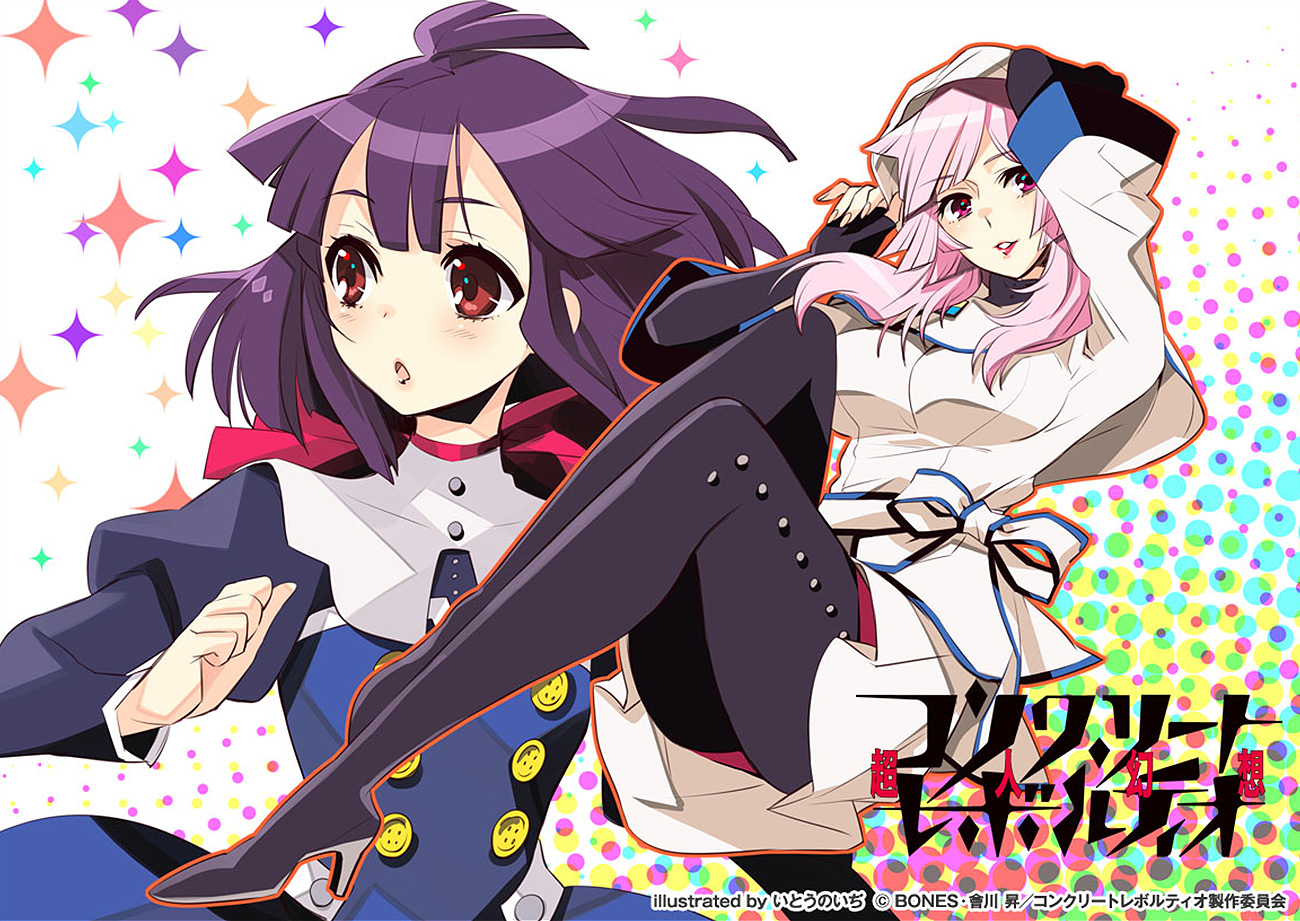
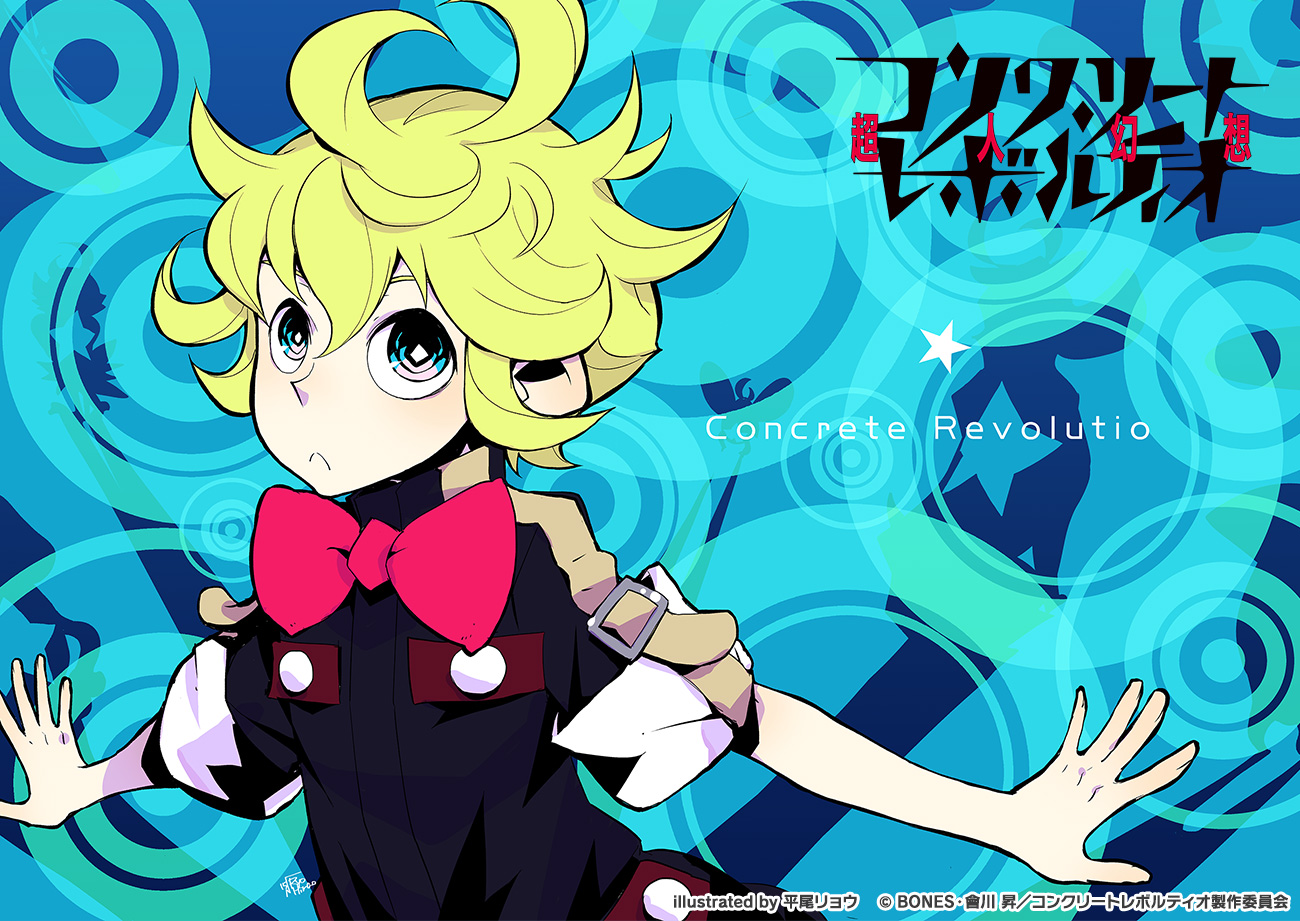
- Staff Relay Comment: Noizi Ito, Hekiru Hikawa, & Ryou Hirao (Character Original Design, Concept) (July 24, 2015)
- Staff Relay Comment: Seiji Mizushima (Director), Sho Aikawa (Scriptwriter) (July 24, 2015)
- Kanetake Ebikawa, Takayuki Nanase, Yoshiaki Ihara, Hideyuki Matsumoto (SF Design Works) (August 7, 2015)
- Staff Relay Comment: Yoshiyuki Itou (Character Design, Chief Animation Director) (August 7, 2015)
- Staff Interview (BONES): Masahiko Minami (President) & Yoshihiro Oyabu (Producer) (September 29, 2015)
- Staff Relay Comment: Kazuki Nakashima (Script) (September 29, 2015)
- Staff Relay Comment: Masaki Tsuji (Script) (September 29, 2015)
- Staff Interview: Seiji Mizushima (Director) & Sho Aikawa (Scriptwriter) (October 2nd, 2015)

Comments From Sho Aikawa (scriptwriter) and director Seiji Mizushima (July 3, 2015)
Seiji Mizushima (Director)
Why were there so many heroes we became obsessed with? It’s been almost ten years since this came up while I was talking with Mr. Aikawa.
Even though we were from the same generation, and grew up watching the same shows, I never thought about that.
When we were children, we certainly enjoyed the neverending appearance of hero shows.
But why? Why were there that many heroes being created at that time? That day, we were engrossed in that conversation until late at night.
After a while, Mr. Aikawa thought up a plan, and that became the basis of the work.
A world where numerous heroes exist. Each one appearing together and being on the level of a main character.
That world is extremely realistic. I thought it was interesting.
I thought, I want to make that. Then, several years passed, and what matured between the two of us is Concrete Revolutio. Our chance has come.
Sho Aikawa (Scriptwriter)
For me, being born in 1965, heroes were on TV right from the start. There was no distinction between tokusatsu, anime, historical fiction, or police dramas. Sometimes, even singers or athletes were equal to them.
To my young mind, there wasn’t a difference between that and reality. The articles about those heroes in magazine publications were, so to speak, just like newspaper reports on real life incidents. And in parks and kindergarten, I could become one of them, and easily suprassed the boundary between those heroes and myself.
Even now, I have memories of that I can never forget.
For just one moment in elementary school, my greatest pleasure was riding my bike. It wasn’t like I was pedaling to actually go somewhere. I just set it on a stand and pedalled my children’s bike in a corner of the yard. In that moment, infinite space spread before my eyes. I’m not joking or making things up. I became a spaceship pilot, and rushed around the galaxy. It’s easy to just decide that was a delusion, a dream, or a child’s make-believe play. But is the possibility of that being reality zero?
When I read Wild Cards, which only had three volumes translated in Japan, I felt like my head was going to explode. The shared-world concept was fascinating, but what really grabbed me was the approach of putting fictional heroes into real world history and intertwining them. Come to think of it, that’s also a common technique in Japanese fantasy novels, which are another favorite of mine.
As I came in contact with the way American comics like The Dark Knight Returns, The League of Extraordinary Gentleman, and Marvels portrayed reality, I wondered what would happen if this was done in Japan. Those thoughts steadily intensified. And then I studied the Showa era that I myself had lived in. When I was a child, I knew from the news and adults’ conversations that something was happening, but I didn’t truly understand it. However, part of that truth had already been fictionalized, depicted by thoughtful creators in “hero” stories. It had reached us a long time ago. It was truly like journaling in your right hand while reading magazines from your left hand.
If the heroes they depicted in these numerous fictional works contained reality, then writing about them was no different from writing about reality.
For a number of decades, I was alone with this revolving phantasmagoria, but in these past few years, I finally made friends who understand, and at last, I gave shape to it.
I don’t care if this is my last work. And no, that doesn’t mean I’m retiring with this. If I could continue to create this work into the future, then I could die happy.
Staff Relay Comment: Noizi Ito, Hekiru Hikawa, & Ryou Hirao (Character Original Design, Concept) (July 24, 2015)
Noizi Ito (Character Original Design, Concept Design)
–Of the main characters, you were responsible for the original designs for Kikko Hoshino, Emi Kino, and Hyouma Yoshimura. What points did you focus on in drawing the characters?
For Kikko, I kept in mind that she would have a more traditional heroine look with a slightly retro taste, and would incorporate her own personal spin on it in order to match this world. I hope I was able to express the rigidity of a girlhood where seriousness and childishness coexist. Her appearance after transforming is also quite different. The changes in her facial expression make her a delightful girl, so I’m looking forward to the broadcast as well!
Emi is the opposite of Kikko in that she has the vibe of a composed, adult woman. At the same time, I made sure she was also cute. I put an emphasis on the fluttering of her clothes, to give her movements a flowing feeling that makes her silhouette beautiful. This time, I was mostly there to design a number of outfits for the two heroines. I will be so fortunate if you look forward to that as well.
Hyouma is kind of like a reliable big brother type to Jirou, so I drew him as a character that I myself would be excited to have as an older brother. After the initial silhouette was decided, even though, in terms of artwork, the character was mine, I had a hard time with him (or rather, I am currently having a hard time with him). But at the same time, I’m also fond of him. Please look forward to the very cool Hyouma!
–You worked together with Hekiru Hikawa and Ryou Hirao to draft the characters. Did working with multiple other people on the designs bring any new discoveries or secondary effects?
I’m trying really hard not to fall behind the stylish designs those two draw. I was inspired by how they easily grasped the goals of the project and the intent behind our orders, and steadily completed the designs. This work has also allowed me to learn and reach new heights of my own. It was a valuable opportunity for me.
–Do you have a message for people who are looking forward to the premiere?
I was blessed with the opportunity to work on a hero show for the first time, and now that the project has been officially announced, I feel a chaotic mix of excitement and anxiety. I was also allowed to draw many supporting characters, so please keep an eye out for this. This is a work where all kinds of heroes exist, from youkai to mecha, and it’s also a must-see human drama. By all means, look forward to it…!
Hekiru Hikawa (Character Original Design, Concept Design)
–You were responsible for drawing the protagonist, Jirou Hitoyoshi. What points did you focus on while drawing?
Because Jirou intervenes in a variety of superhuman cases each episode as a member of the Superhuman Bureau, I put together a design with the image of a black-suited agent rather than a hero. I think it’s best if I could create a sense of “normalcy” that’s close to the viewer’s values within the special setting of the Shinka era, which is a world overflowing with a creativity that’s closely related to a feeling of being out of place. Seeing Jirou along, he gives a feeling of being quite mild-mannered, and that’s precisely why you should look forward to seeing him get tangled up with various characters.
–You worked together with Noizi Ito and Ryou Hirao to draft the characters. Did working with multiple other people on the designs bring any new discoveries or secondary effects?
The two of them are amazing people, so I would be shook whenever they would show me their designs, but it was extremely exciting that we’ve been able to bring out the work’s depth by creating a variety of designs I wouldn’t be able to do alone. Concrete Revolutio is a story where each episode has unique characters and idiosyncrasies, so I think having designs done by multiple people allows us to directly express that diversity.
Initially, Hirao and I did the concept design. But since our respective direction was different, every time we would come together with our designs, I would get really motived because it was like, “Hirao is amazing!! There’s stuff like this, too?!!” After that, Noizi joined, with designs for Kikko and Emi that took a completely different approach from us, so we were surprised, like, “This is amazing too!!” The many phases the characters went through to become what they are now were all terrific, so it was really interesting to see how they were polished each time. After all the extra motivation I got, I get the feeling I improved a little, too. (laughs)
–Do you have a message for people who are looking forward to the premiere?”
The introduction and comments from Director Mizushima and Aikawa are exciting enough on their own, but it’s so amazing that I can’t really explain!
The different superhumans that appear in Concrete Revolutio are burdened in various ways due to their powers, and that’s like a separate work in and of itself. The enjoyment of seeing that intersection, as well as the impressiveness and out of place feelings of the existence called superhumans, and the various differences in values from having all of these things that won’t converge into one lineage — the drama of interweaving these is very fascinating, so I really hope you will enjoy it. As one of the original character designers, the pressure of that responsibility is nerve-wracking, but I did my best and put all my effort into each design, so please, let’s travel the Shinka era with Jirou together!
I hope you’ll tune in to the premiere in October.
Ryou Hirao (Character Original Design, Concept Design)
–You were responsible for designing one of the main characters, Fuurouta. What points did you focus on while drawing?
Fuurouta is undeniably a wild character (though perhaps there is some thought deep within his heart), and even when he’s opposing something, he goes at it in an oblique way, giving him a disposition that’s maybe a bit like a comedian’s. I hope that sort of feeling comes out, from his big, round eyes, to his hairstyle and clothes…!
Also, since there are lots of different ways he can transform, I struggled to create something that feels like it has the “core” of Fuurouta at all times. He was always testing my drawing ability…! He transforms any number of times in a single episode, so I’ll be happy if it’s enjoyable for the audience as well.
–You worked together with Hekiru Hikawa and Noizi Ito to draft the characters. Did working with multiple other people on the designs bring any new discoveries or secondary effects?
It was certainly exciting! When Hikawa would hit the ball one way, Director Mizushima would say, “Do it this way!” and when Noizi would come at it another way, he’d say, “Do it this way!” The three of us kept hitting the ball back to him like that in order to make the world of Concrete Revolutio even more interesting.
Collaborating with the two of them has allowed me the breadth to draw things I couldn’t normally, and I have enjoyed that greatly. Yoshiyuki Itou, who compiled all of this onto the same screen, is truly amazing…!
–Do you have a message for people who are looking forward to the premiere?
This is a work that will undeniably keep the entire staff’s heat — their passion — bursting out. Us character designers aren’t going to be left behind, either! We’ll keep heating things up with our passionate drawing, so I think you’ll definitely, definitely enjoy the premiere! Please stick with us!!
Staff Relay Comment: Seiji Mizushima (Director), Sho Aikawa (Scriptwriter) (July 24, 2015)
Seiji Mizushima (Director)
–I believe one of the themes in Concrete Revolutio is “superheroes,” but what do you want to depict through the work?
I think this is a predictable answer, but wouldn’t it be about every human’s, and every superhuman’s, various ideas of justice?
And also what justice is? What is an ally of justice? What is a hero? What is society?
While thinking about all of that, I want to represent the various characters in a rich way.
–As we look towards the premiere, I believe the production is beginning to enter its climax. Please tell us what you are most enthusiastic about.
The story Sho Aikawa weaved has parts that are pretty serious, but it also has a lot of playfulness, so without harming any of that, I amplified its charm even further, using the visuals and the music, so it’s bursting with playful energy!
At times it’s bold, and at times it’s delicate.
I wanted to depict Concrete Revolutio‘s world as one that isn’t simple.
–Do you have a message for people who are looking forward to the premiere?
I think you know this from the trailer, but this is a work where, one after the other, interesting superhumans (or superhuman-like humans) are gathered together!
They haven’t been announced yet, but many more superhuman (seeming) people are interested in taking part in the work! That energy and earnestness will be sublimated into pure entertainment and delivered to all of you!
We’ll do our best!
Look forward to Concrete Revolutio: Superhuman Phantasmagoria!!
Sho Aikawa (Scriptwriter)
–As the scriptwriter of Concrete Revolutio, and especially as the original creator, you shoulder the burden of the work’s very foundation. Please tell us about this passion.
The only times I’ve been credited as an anime’s “original creator” are when I’ve proposed the project myself, or when I’ve created the fundamental parts of it. BONES in particular has allowed me to work as the original creator for two works: Karakuri Kiden Hiwou Senki, which was primarily from Masahiko Minami and Hiroshi Osaka, and Tenpou Ibun Ayakashi Ayashi, which was put together in a rush due to the cancellation of a certain project.
One day, in the middle of all that, Minami gave me a push by saying to me, “The next time we do a project together, it needs to be something that says ‘This is Aikawa.’” I’ve devoted myself to pouring everything inside of me into this work. I’ve also never written a supplemental novel for an anime I’ve worked on, but this time I am deliberately taking on the challenge (it’s currently being published in Mystery Magazine).
Thank you, “This is Aikawa.”
–What kinds of thoughts did you put into the protagonist, Jirou Hitoyoshi?
I have yet to have the opportunity to speak with Mr. Hikawa, but he was an interesting person to me since before the project. His surreal material is covered with amazingly cute girls, and is cool as well. but more than anything, the bunch of works that Director Mizushima and myself were involved with feel like they’re in such a faraway place that it was fascinating. The Jirou that Mr. Hikawa drew for us during the project’s planning stage decided the image I had of him in my head. Jirou was originally supposed to be a more cynical and cool character like in FMA and UN-GO. But perhaps that wasn’t for the best. Now he’s more honest, and will assert that what is right is right and what is wrong is wrong. Having such a straightforward character may have allowed him to become a vehicle for our feelings towards the work. That’s how I came to feel about him.
–Do you have a message for people who are looking forward to the premiere?
During the time we spent in the planning phase of the project, something happened in Japan that I never thought would: there was a surge of popularity surrounding American comic-based films, which caused many superhero-themed anime to be created and become hits. Because of that, you may have already formed an idea inside of yourself about what this work is. However, that idea is incorrect. This is not a superhero story (the word “hero” barely shows up in the work to begin with), and it’s also not a parody of any specific tokusatsu show. It’s something probably nobody has seen before, but it is still something with a universe that you can easily understand once you watch it. It’s meant to be that kind of special series.
Director Mizushima, Animation/Character Designer Ito, Art Director Matsumoto, Sound Director Mima — all of these people have coordinated their schedules to put their time into creating this work that they understood was something new. Right now, the one who who wants to see Concrete Revolutio the most is my. I hope my excitement reaches you, too.
[not-sophie note: Tokusatsu means special effects and these are usually superhero shows or monster movies blah blah etc. Sho Aikawa only listed the last names of Masahiko Minami and Hiroshi Osaka so I added their first names to make your life easier. He also did not actually say FMA (he used the Japanese abbreviation, HagaRen) but in case you don’t know what that is anyway, it’s Fullmetal Alchemist. ALSO. On the site they actually included a few questions for people this particular entry was not supposed to cover (they weren’t mentioned in the title), and those questions are included along with actually more questions for those specific people in the next entry. I’m taking their inclusion here as a mistake and so I am not including them here. Next one’ll have them.]
Kanetake Ebikawa, Takayuki Nanase, Yoshiaki Ihara, Hideyuki Matsumoto (SF Design Works) (August 7, 2015)
Kanetake Ebikawa (SF Design Works)
–Tell us about the special characteristics of Concrete Revolutio‘s mechanical design that sets it apart.
It’s not modern, but it’s also not retro-future…
Maybe it’s like a toy box design that makes a statement without being too loud about it?
–What parts were difficult when you were doing the design work?
I’ve done a lot of different designs before, but this was the first time I did a job that had this much variety in its designs.
There were both difficult parts and fun parts.
–Do you have a message for people who are looking forward to the premiere?
Even I’m excited to see what type of work this will become from here. (laughs)
Let’s look forward to Concrete Revolutio together!
Takayuki Nanase (SF Design Works)
–Tell us about the special characteristics of Concrete Revolutio‘s mechanical design that sets it apart.
This time, instead of “mechanical design,” I’m doing the job of “SF design works.” Honestly, I haven’t drawn many mecha for the show. The designer camp did a wide variety of designs, with a little bit of mecha, and then mostly things like superheroes, monsters, and vehicles. They have a nostalgic feeling to them, but of course we’ve also aimed to create proper, sharp sci-fi designs.
–What parts were difficult when you were doing the design work?
There were a lot of orders for things of a genre I’ve never drawn before. For now, I’m trying to draw them, but each one is a lifetime of struggle. And there’s also some that use a certain period of the past as the basis for their setting, and collecting sources for that has been difficult. Things like insect identification manuals, kaiju encyclopedias, and old types of bikes… My number of reference materials has increased for the first time in quite a while.
–Do you have a message for people who are looking forward to the premiere?
It’s been tough, but I enjoy the challenge. I hope the fun I’ve had is apparent from the designs and the work itself.
Toshiaki Ihara (SF Design Works)
–Tell us about the special characteristics of Concrete Revolutio‘s mechanical design that sets it apart.
I suppose I would say, “it was like it was there, but it wasn’t” or maybe “it was like it wasn’t there, but it was.” Or maybe like the designs give a feeling of some kind of deja vu.
Though I don’t think I was able to put it into words at all.
–What parts were difficult when you were doing the design work?
Vehicles, particularly ones that actually existed, or are otherwise based on real ones, are difficult, or should I say, troublesome, to draw. Perhaps it will sound like I am making excuses, but to make something look “like” something else while changing things or removing parts, I have to completely, in my own way, understand all of its structural elements first or I can’t proceed, so I have to spend a very long time looking through and at reference materials while groaning…
–Do you have a message for people who are looking forward to the premiere?
There are various heroes and mecha that appear, but I think it will also be fun to imagine what their backgrounds and representations will be when watching it.
Hideyuki Matsumoto (SF Design Works)
–Tell us about the special characteristics of Concrete Revolutio‘s mechanical design that sets it apart.
I think the most unique characteristic is the fusion of a retro setting with mecha.
–What parts were difficult when you were doing the design work?
Like I wrote before, it was difficult to arrive at a design that blended those elements together. From giant mecha to things smaller than normal humans, from the vicious to the cute; there was such a variety of mecha and creatures that I had to painstakingly turn the designs over and over again in my head.
–Do you have a message for people who are looking forward to the premiere?
Every episode has an extensive variety of characters and mecha appearing, making it a very lively work. I think there’s something for everyone to enjoy in it.
Staff Relay Comment: Yoshiyuki Itou (Character Design, Chief Animation Director) (August 7, 2015)
Yoshiyuki Itou (Character Design, Chief Animation Director)
–When you were designing from the character drafts created by Hekiru Hikawa, Noizi Ito, and Ryou Hirao, what points did you focus on?
This time, we have three creators designing numerous characters. I’d say I’ve been working with them on the designs with the thought that my duty is to bridge three parents who have been entrusted with taking care of a precious child, and sending it into this work’s universe. How do the various characters in Concrete Revolutio‘s world go about their lives, and how do we make them feel alive? That’s what I keep in my thoughts while working.
–Tell us about the special characteristics of Concrete Revolutio‘s character design that sets it apart.
The special characteristic is each of the designs themselves!!
Without worrying too much about consistency, they all coexist on one screen (world). I think that’s a unique characteristic that people will find charming.
I’d love it if people can enjoy it thinking like, “When?! What time?! In which episode?! This character!!”
–Do you have a message for people who are looking forward to the premiere?
The premiere is scheduled for this fall, in October. Along with the taste of fall and other delicious things, enjoy the various flavors this anime called Concrete Revolutio: Superhuman Phantasmagoria has to offer. You are sure to come across some that are unexpected and surprising. Look forward to the premiere in October!!
Staff Interview (BONES): Masahiko Minami (President) & Yoshihiro Oyabu (Producer) (September 29, 2015)
[not-sophie note: The video message on this page, other than the very first question, is almost verbatim what is in the written section (except the written section straight up has more), and offers no new information, so I translated their introductions and the first question from the video message, and then the final three questions are all from the written portion.]
Minami: I’m Masahiko Minami, the current President of the animation production studio, BONES. I’m doing the project planning for Concrete Revolutio.
Oyabu: I’m a producer at BONES, and I’m also the producer of Concrete Revolutio. My name is Yoshihiro Oyabu. It’s nice to meet you.
–How did Concrete Revolutio come to be?
Minami: The project’s core is Director Mizushima and Aikawa, but I’ve been working with them as a team since we did a project called Fullmetal Alchemist. That was when we first decided we should try to work on something new and original together.
–Please tell us your impression of the protagonist, Jirou Hitoyoshi.
Minami: He’s a character that I actually haven’t fully been able to grasp myself. On the surface, Jirou is holding back “something huge” inside him that he can’t let out. But since it’s Aikawa’s extremely polished script, whenever I hear Jirou’s lines, I think about what kind of deeper meaning each one might be holding.
Anime characters’ charm ultimately comes down to how the visuals, sounds, and everything all combine together, so I’m really looking forward to seeing how Jirou, with his overflowing appeal, will be received by the audience after the first episode.
Oyabu: When I read the scenario, when I see the art, when I hear the lines, each of these things gives me a different impression of him. At first, I thought he might be a more cool-headed character, but I’ve come to think he’s actually quite passionate. Because of that, I think Concrete Revolutio: Superhuman Phantasmagoria is an even more interesting work if you try to watch it from his perspective.
–This work’s use of such renowned individuals as Noizi Ito, Hekiru Hikawa, and Ryou Hirao as the original character designers has become a subject of much conversation. Please tell us why the decision was made to hire multiple people to work on the character drafts.
Minami: Since this is a work where a lot of superhumans appear, I was thinking it would be best to aim for a ton of variety to broaden the setting. But because all of the creators were extremely unique, there were some concerns about if they would all fit into the same world. But that ended up coming across as the personalities of each character, and as that came through in the art, I thought it was truly fascinating.
Oyabu: The idea to have multiple designers creating this one world was in Director Mizushima’s head right from the start. That became a reality once Yoshiyuki Itou joined the project as character designer. With the strategy that he would be able to unify extremely unique characters into one world together, the three distinctive designers Noizi Ito, Hekiru Hikawa, and Ryou Hirao were tasked with the original drafts of the characters. Actually, we had several other famous guest designers join the project as well to help create living, breathing characters.
–Do you have a message for people who are looking forward to the premiere?
Minami: As an original BONES work, it’s full of passion.
Older generations will likely be left with a nostalgic impression, and those in their 20s and 30s could come to see it as something that makes them think about the philosophy of life. Teens should be able to get a lot of enjoyment from things like its action scenes and others, since it is a modern-day animation. I think everyone will be able to enjoy it a lot, because it’s that sort of charming work.
Oyabu: During its development and production, I was acutely aware of how we have young creators and creators in their 40s and 50s working together and having a lot of fun while working on the project. The young creators got to learn about old tokusatsu programs and hero anime they didn’t know about, and those in the more middling ages got to start waxing nostalgic, like, “Oh yeah, they had things like this, too.” Then they could start talking about the differences and similarities between their generations and worldviews. This kind of derailment could easily continue for an hour, and it happened a lot.
The talented staff put in no less than their greatest effort to cut through all the work — the art was also created with a ton of spirit. The music was rich with amazing variety thanks to the musicians who participated in the project, too. This has become a work that is filled to the brim with enjoyable factors in its art, sound, and effects, so please do look forward to it.
Staff Relay Comment: Kazuki Nakashima (Script) (September 29, 2015)
–What kinds of orders did you receive from the original writer, Aikawa?
Old manga, anime, and hero homages that we liked were ordered. There were also things like “events from the real-world Showa era that are linked to our fictional Shinka era” that were requested to be in episodes depicting the actions of the Superhuman Bureau. It was actually quite difficult to include all of these at once.
Plus, the episodes I was put in charge of featured different kinds of relationships between the characters, so I felt like I had to slowly feel everything out.
–What are the highlights of this original work?
After reading multiple finalized episode scenarios, the works’ basis is from Showa-era entertainment, that historical point of view, and the ideas and themes of the time. It was very powerful, and no doubt a large part of it was from Aikawa himself. That’s how it felt to me.
Director Mizushima took that deep original material and digested it into something that can be entertainment for anyone. Look forward to the premiere!
–Do you have a message for people who are looking forward to the premiere?
This was a project that Aikawa would have wanted to write even on his own, but since he specifically called on me to be a guest writer, I thought I’d take the opportunity to write something that stood out a little from the rest.
I think you’ll be able to open your mind to enjoy these parts as Concrete Revolutio as well.
Staff Relay Comment: Masaki Tsuji (Script) (September 29, 2015)
–What kinds of orders did you receive from the original creator of the work, Sho Aikawa?
I recall that I didn’t ask him to explain everything, because I wanted to understand it without any preconceived notions. I think I might have been excited just to be called in for it.
Having seen many of Aikawa’s works, I surmised that it would certainly be a project that wasn’t concerned with numbers. Taking part in the script creation, I felt that was the case even more strongly.
–Please tell us the highlights of this original work.
It’s filled to the brim with ideas. If the audience finds it difficult to digest, it might be that their thinking muscles have gotten weaker from only watching works that don’t pose any challenge.
If you’re a viewer who has seen a lot, your brain muscles will be buff from all that exercise, and you’ll be able to go head to head with this work and hopefully put it all together. The highlights of the work are all over. Searching for those while salivating is how you’ll taste the ultimate flavors of anime appreciation.
–Do you have a message for people who are looking forward to the premiere?
Our staff is pitching everything they’ve got into this. Brace yourselves solidly to catch all of the powerful things we’re throwing at you. I believe this work conceals that much bite and weight within it.
The setting, characters, animation, direction, voice talent… Everything will definitely meet everyone’s expectations.
The number one thing I’m looking forward to seeing is actually my own work.
Staff Interview: Seiji Mizushima (Director) & Sho Aikawa (Scriptwriter) (October 2nd, 2015)
–Now that voice recording has begun, what are your thoughts on it?
Mizushima: I think we’re steadily realizing what I’d hoped for. From here, we’re putting together the visual and audio aspects, and I’m getting closer to feeling like we’ll be able to deliver something interesting that will meet everyone’s expectations.
The performances of the voice actors have exceeded our imagination. Having them look into the meanings of things and come together by agreeing, “this is foundational to this character” or thinking, “the nuance here is a little different. I wonder why?” has helped the staff team to further deepen their understanding towards the characters. It’s super fun to play catch with them in this way.
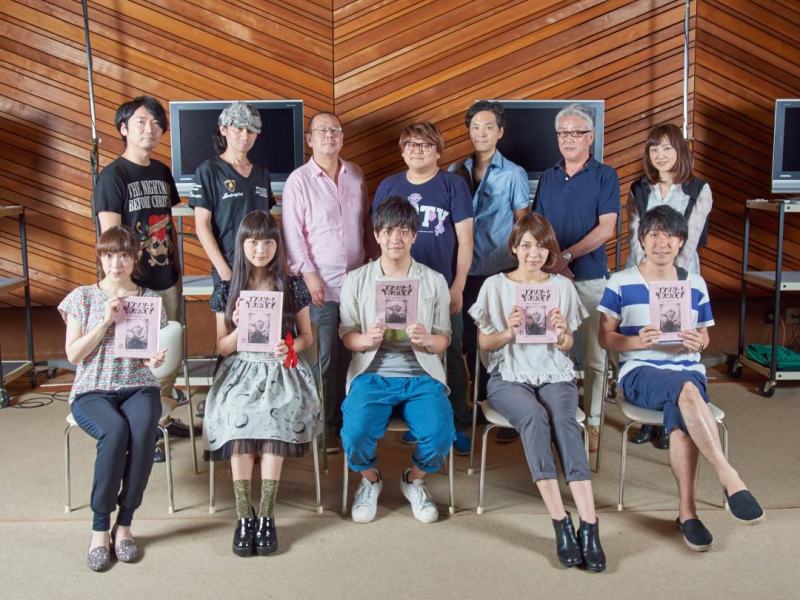
Aikawa: I think having younger people and veterans combine their strong points elevated its impact in a huge way. We couldn’t anticipate what kind of acting we would end up having with this ensemble. I’m extremely satisfied with it. We used up all the time we had been given, but still hadn’t finished recording. We had to carry it over to next week. Ordinary anime are almost never given such luxuries in their creation, so I think we’ll be able to meet the expectations of everyone who is looking forward to it.
–Which parts of the work do you want people to pay extra attention to?
Mizushima: Of course the story and the trickiness of its composition are highlights, but I think the animation and cool parts of the action and the use of colors and background art that makes everything pop, and seeing how those two aspects meet, feels really interesting to watch.
Aikawa: It’s the devices that make the work something that doesn’t end after you see it, like when you think “Oh, what did they just say?” and, while curiously looking it up online, you find completely different information. It’s also full of devices so that, after viewing the work, each individual audience member will create various worlds inside of themselves.
The works I’ve participated in always have those sorts of layers and ambiguity, but this time, I think that feeling is extremely strong, so I hope people will read into those moments, and I think they will enjoy them.
–Do you have a message for people who are looking forward to the premiere?
Mizushima: The broadcast of Concrete Revolutio: Superhuman Phantasmagoria will finally begin on October 4th. For us, creating this project together is a reunion, with Aikawa as the scriptwriter, Yoshiyuki Itou as character designer, and with BONES producing, just like how we created works together in the past.
Those who are doing the original character design drafts and the mecha designs are also friends we’ve collected throughout our careers, so I’ll be delighted if you can take interest in watching this work we’ve all come together as one team to create. Thank you.
Aikawa: I’m expecting Concrete Revolutio: Superhuman Phantasmagoria, more than just being a sort of compilation of the types of things we’ve worked on up until now, to be a work that’s thought of as having started something new.
I’d be grateful for young people to be excited by watching it, and I also think that people of older generations such as myself will be plenty satisfied by it. So I hope people from a very wide range of ages will look forward to and enjoy it.



 THE TRASHLATION BLOG
Leave a comment